
The FEE archives are full of correspondences. Many of these letters contain interesting discussions on the economics, politics, and philosophy of liberty. Shifting through them it becomes clear that those in the liberty movement truly cared about obtaining a better understand of how society works. This letter from Rose Wilder Lane to Leonard Read on September 16, 1950 is a perfect example of this. Lane was a journalist, political theorist, and novelist (her mother wrote the little house series and Lane contributed to the series herself). She is probably best known in libertarian circles for her book the Discovery of Freedom. But lane was certainly not a monetary theorist. Still, Lane wanted to understand and in this letter attempts to explain to Read what she believes is the nature of money.
As Read’s notes in the margin indicate Lane’s thoughts are not exactly correct. The letter contains many fallacies regarding money but it also shows that Lane was a brilliant thinker in her own right. After all she was not an economist and is approaching this topic without any training on the subject. Still, the letter is worth reading for young aspiring economist if only to see where her thoughts went wrong and what she got right.
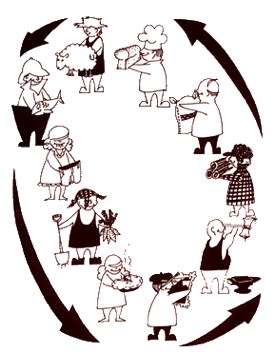
The main problem with Lane’s position is that she approaches the subject from the wrong starting point. She views money as a measure of value instead of a medium of exchange. It is true that money is a measure of value – money has an objective exchange value, however, the ability to measure this exchange value is not why money is money. Money is money because it is generally accepted throughout society – it is a commonly accepted medium of exchange. Barter, or direct exchange, contains a major flaw in that it requires a double coincidence of wants. If person A wants what person B is selling, person B must want what person A is selling. In our modern economies, where we are highly specialized in the division of labor, this will often be a problem. Thus money emerges as a way of indirect exchange; i.e. it is through a commonly accepted medium of exchange that the problem of the double coincidence of wants is solved.
The process in which money emerges is spontaneous and can be seen through Carl Menger’s (the founder of the Austrian School of Economics) story of the emergence of money. This is in complete opposition to Lane’s position. She gets the starting point wrong because the measure of the objective value of money is not why money is money. She is right that value is subjective but it should not be the cause of concern she makes it out to be. The only measure of value comes from the individual by comparing two economic goods. For exchange, one does not need to know what exactly the other person values for that good in a numeric term, he only needs to know that there is a double coincidence of wants, and that’s all! Money helps provide this double coincidence of wants by being a commonly accepted medium of exchange.
So, how else do you think Lane went wrong? How was she right? There is a lot in this short letter. Share your thoughts in the comments.
Download the Lane to Read Letter of September 16, 1950 here.
(I would like to thank my colleague Simon Bilo for help working through a better understanding of Lane’s position.)