Home » Media, Video \ Tags: , , , , ,

The Classical Liberal Tradition: Marx v. Smith

The Classical Liberal Tradition: Marx v. Smith

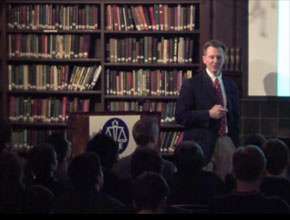
Professor James Otteson spoke to students attending the Freedom 2010 Homeschool Debate Tournament held at FEE on March 5th, 2010.

James Otteson is a joint professor of philosophy and economics at Yeshiva University in New York and Charles G. Koch Senior Fellow at the Fund for American Studies in Washington, DC. He has previously taught at Georgetown University and at the University of Alabama.

Technical note: We apologize for the minor audio feedback present in some of this video. Due to the importance of the material we decided to post the video despite the defects.

9 Comments »

  1. where does austrian economics come in and keynes.

  2. I’ve repaired the audio quality (not perfect but much better)

    You can download the video (mp4) from

    https://depot.uni-konstanz.de/get/rgamtt

    to administrator: Please repost this version and delete my message

    best,
    anthony

  3. to the administrator

    is it possible to make the powerpoint file downloadable ? much aappreciated

    thx a bunch

  4. I changed the ppt to a downloadable PDF file. Cheers!

  5. Now, I am no expert, but I have read the Republic a couple of times and it seems that the interpretation at the beginning of this video could be disputed:

    Socrates never really offers a theory of government, he merely asks the question, how does one make the best society (and honestly I can’t remember if it is Socrates who asks it or one of his students).

    So the students come up with answers such as, “One ruled by the best people.” And Socrates then says, “OK, who are the best people?”

    And the students say, “the philosopher kings.” And so it goes. Socrates is not advocating that this is the best society, he is merely going with the suggestions and taking them to their logical extreme through questions…such as, what would a philosopher king do to make a good society? And the students come up with things that would inevitably restrict personal freedom.

    Each time the students suggest a way to make the perfect society, Socrates shows them the implications of their proposals, which involve more and more top down control of individuals until finally the government controls everything. He shows them how preposterous it is to try to control people.

    It seems that it could be said that Socrates was actually trying to show them the folly of trying to create the perfect society in the first place. All of the students suggestions sounded good, but when Socrates forced them to take each of their ideas to its logical extreme it became clear that the original idea was preposterous.

    Therefore, it could be disputed that Socrates favored the total state. In fact, seen this way, it could be argued that he supported exactly the opposite.

  6. To Matthew Akin:

    Thank you for your note. You offer an interesting, if a bit fanciful, interpretation of Plato’s Republic. It would have been a lot of trouble to go to–writing an entire book filled with careful and rigorous arguments–if it served only the hypothetical purpose you describe. Isn’t the far more natural interpretation that Plato had very definite positions for which he attempted to argue, using Socrates and his interlocutors as his mouthpieces?

  7. Perhaps you are correct. But it seems more consistent with the approach that Socrates takes in all his dialogs to assume that he begins with no position of his own. He merely takes the position of those around him to their logical extreme, and thereby shows them the folly of their original beliefs, which they have never followed to their logical conclusions before. He may seem to be advocating the position, but it is only to get the student to think about it more than they have before, and in this way, he is actually exposing the absurdity of original assertions.

    In the case of the Republic, each idea for creating the perfect state is followed to its end, until it is seen that the vast amount of absolute controls that would be required to implement such a utopia–such as outlawing the poets and artists, controlling who could reproduce, etc.–are so absurd that Socrates actually exposes to the students the absurdity of trying to implement them in the first place.

    I realize this is not the standard view of the Republic. I will clearly have to read the Republic again, since it’s been awhile, but I’m not sure this is completely a fanciful interpretation. Maybe it is…but maybe the standard view is also a misreading.

  8. Interestinly, the Mises institute just published an article by Anders Mikkelsen that does a better job of presenting my arguments than I did:

    http://mises.org/daily/4201

    I’m not the only one who has seen the dialogs of the Republic as “using irony to ridicule the views of justice expressed by the Athenians in the dialogue.”

  9. Hi thanks for the great infomation your web site has to offer.
    I look ahead to reading more about your site.If You
    Looking to obtain the latest books
    on your Kindel or Nook Please Give Audible a attempt with there free trial
    supply and get a free Audio E book Obtain
    just for Giving Us a Try.No Risk Hassel Free Audio E book
    Downloads!
    Audible Bible

Have your say!

Add your comment below, or trackback from your own site. You can also subscribe to these comments via RSS.

Be nice. Keep it clean. Stay on topic. No spam.

You can use these tags:
<a href="" title=""> <abbr title=""> <acronym title=""> <b> <blockquote cite=""> <cite> <code> <del datetime=""> <em> <i> <q cite=""> <strike> <strong>

© 2009 | Foundation for Economic Education | 30 S Broadway, Irvington-on-Hudson, NY 10533 | 1-800-960-4FEE (1-914-591-7230) | Fax 1-914-591-8910 | Log in