A new 90-minute documentary showcases the greatness of the economist Ludwig von Mises to the world.
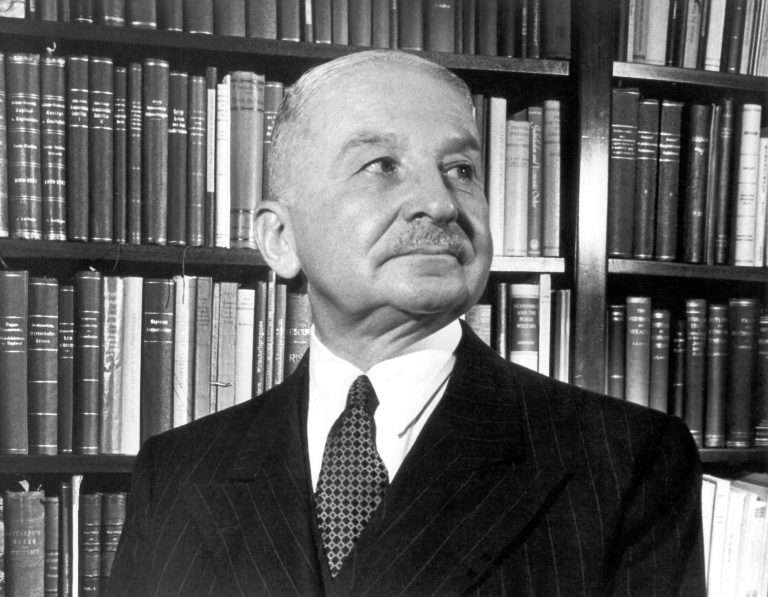
Have you ever checked to see which famous people you share a birthday with? My special date is September 29. The list of notables born on that date is impressive but everyone on it pales in honor and significance to that of the late Austrian economist, Ludwig von Mises (1881-1973).
Now, happily, a 90-minute documentary proclaims this man’s greatness to the world.
The name of Mises is no stranger to these pages. FEE’s founder, Leonard E. Read, put Mises on the FEE staff early in the organization’s history. Our online archives are loaded with articles by and about Mises. One of our former presidents (and my Economics mentor at my undergraduate alma mater), Hans F. Sennholz, earned his PhD under Mises’s tutelage.
Mises earned “Giant” status in the Economics profession for his numerous contributions. He explained socialism’s “inability to calculate” as a fatal error, a keen observation that to this day no socialist has effectively countered. He, along with his star pupil F. A. Hayek, developed a theory of the trade cycle that proved it to be the result of inflation of money and credit by government. He championed “praxeology,” a methodological approach to economics that stresses the centrality of purposeful human behavior and subjective value. I could go on and on, but I’ll let the new documentary and the recommended readings below fill out the list.
The film draws its name from Mises’s 1949 magnum opus, Human Action. Credit for its production goes to Jacek Spendel and Marcin Chmielowski and their team at the Freedom and Entrepreneurship Foundation in Katowice, Poland.
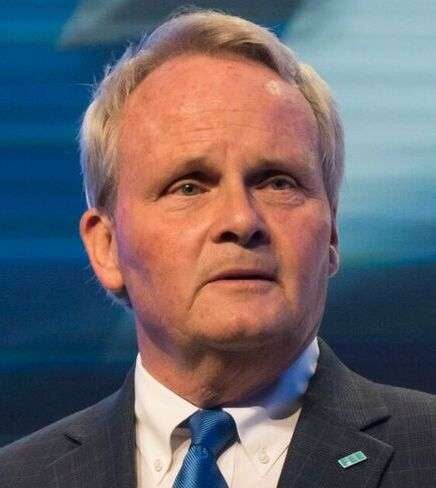
All of us at FEE are proud of the prominence of our organization in the content, which features extended clips of a November 2019 interview Marcin conducted with me in Atlanta.
Today is the official date of the film’s public premiere in Vienna, Austria, where Mises studied, taught, and advised. Thanks to an advance “sneak peak,” I can affirm its great value in telling new generations about this remarkable economist.
Watch the film, and you will learn about the Mises family background in commerce, banking and engineering; the vibrant culture of Vienna a century ago; Mises’s personal role in preventing Austria from slipping into communism after World War I; the unusual commitment of Mises to helping female economists get established at a time when women had few doors open to them in the profession; and the seminars the great man conducted at FEE and at New York University after he and wife Margit emigrated to the United States.
As the credits roll, you will even hear the voice of Mises himself as he lectures on the social science he loved and to which he bequeathed so much.
That’s enough from me. Now grab the popcorn and enjoy the movie!
For additional information, see:
The Essential von Mises (a free FEE eBook)
Ludwig von Mises: An Unthanked Prophet in His Own Land, by Bettina Greaves
The Man Who Can Still Liberate Mexico, by Lawrence W. Reed
What Human Action Means to Me and to FEE, by Lawrence W. Reed
Missionary for Free Markets: Hans F. Sennholz by Lawrence W. Reed
Ludwig von Mises: A FEE Selection of His Articles